


Collabstr Annual Influencer Marketing Report 2026
Since 2022, Collabstr’s annual Influencer Marketing Report has captured and shared the data and insights shaping the future of creator marketing. And this year, we’re back with an even deeper look into where the industry is headed in 2026.
Using anonymized first-party marketplace data, we analyzed more than 21,000 collaborations and more than 200,000 creators on our platform. We've uncovered what really moved the needle this year, from the top platforms and fastest-growing niches for influencer marketing to average creator pricing across content types.
This report will explore how the influencer economy has evolved over the past year, and the data-backed trends defining what comes next for both brands and creators. For a closer look at how far things have come, don’t forget to read our 2024 and 2025 influencer marketing trends reports.
Key Takeaways
-
The number of TikTok-specific campaigns dropped (-48%) while user-generated content (UGC) campaigns grew (+133%) on the Collabstr platform.
-
Beauty and fashion were among the most popular niches and also the most affordable for brands who wanted to work with creators.
-
Small budgets dominate with nearly 80% of brand collaborations costing under $300.
-
Brands are using short-form content for reach and awareness and long-form content for building engagement and trust (e.g., IG Reels vs. YouTube videos).
- What’s Driving Steady Growth in Influencer Marketing?
- Influencer Marketing Solves for the Audience Trust Gap
- Influencer Content Fits into the Experience of Social Feeds Better
- Influencers Offer Access to Communities
- Platform Trends and Pricing
- Top 5 Social Media Platforms for Influencer Marketing in 2026
- How Much Are Brands Spending per Engagement?
- Average Influencer Rates by Platform vs. Average Influencer Cost
- Creator Niches and Pricing
- Top 5 Influencer Marketing Niches
- Fastest-Growing Influencer Niches
- Fastest-Growing Niches: What’s Driving Their Rise?
- Top 5 Most Expensive Niches
- Top 5 Most Affordable Niches
- Content Types and Performance
- What Type of Content Are Brands Requesting Most?
- Top Social Media Influencer Content by Reach (Impressions)
- Top Social Media Influencer Content by Engagement
- User-Generated Content
- 3 Reasons UGC Campaigns Are Attractive for Small Businesses
- Demographics and Geography
- Top Niches by Gender
- Male vs. Female Average Earnings: The Pay Gap Persists
- Top 5 Cities for Influencer Talent in the US
- Top 5 Cities for Influencer Talent in the UK
- Top 5 Cities for Influencer Talent in Canada
- Looking Ahead: Three Predictions for 2026 and Beyond
- UGC Is Paving the Way for Smarter, Scalable Influencer Marketing
- High-intent, Expert Content Is Becoming More Valuable to Brands and Audiences
- Small Budgets and Micro-Engagements Will Continue to Make Up the Majority of Influencer Engagements
- Putting These Insights into Action With Collabstr
What’s Driving Steady Growth in Influencer Marketing?
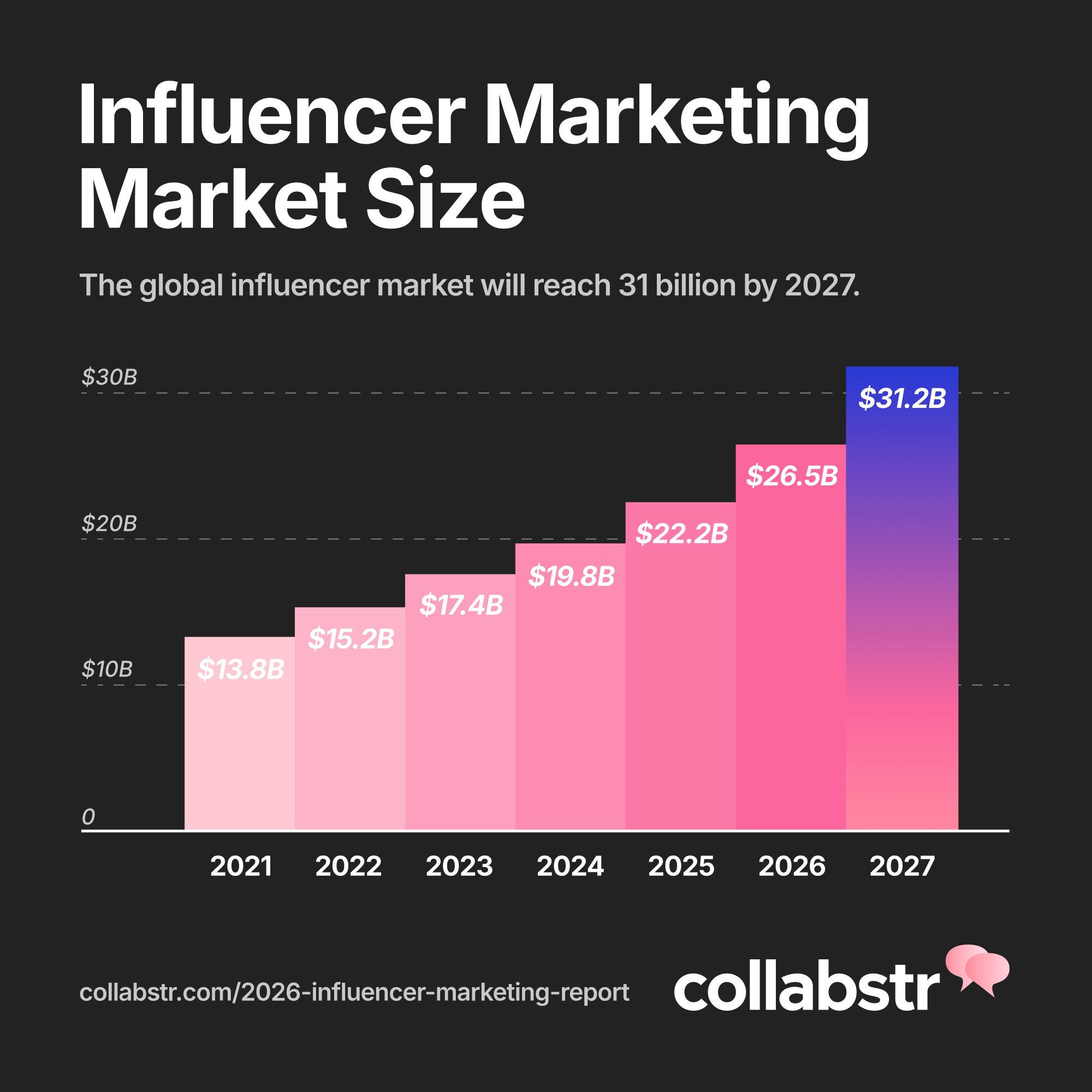
Global influencer marketing is a high-growth industry, expected to continue expanding as businesses explore scalable strategies for reaching new audiences. In fact, HypeAuditor estimates that the global influencer market will reach 31 billion by 2027.
For brands focused on trust, for younger audiences, and for real demand signals, influencer marketing has become the most efficient way to build credibility and generate organic excitement for brands, products, and launches.
And it’s easy to understand why. In Sprout Social’s Pulse Survey, 83% of respondents said that influencer content outperformed brand content across key metrics (reach, engagement, conversion) by up to 92%. Here’s what may be fueling this industry growth and engagement.
Influencer Marketing Solves for the Audience Trust Gap
Online audiences are inundated with polished feeds, products that over promise, and celebrity endorsements that no longer land. The right influencer marketing strategy can bridge the trust gap—cutting through corporate brand talk with community-centred moments of discovery.
In 2025, 61% of consumers said they trust influencer endorsements more than traditional advertisements, meaning that attention hasn’t dwindled, it’s just been redirected.
Influencer Content Fits into the Experience of Social Feeds Better
Brands are often beholden to internal rules around tone of voice, messaging, brand risk, and no-go concepts. The result? Perfectly curated, on-brand messages that stick to brand guidelines but rarely inspire action.
Influencer content, on the other hand, can often be bolder, trend-forward, and more ephemeral in its effort to engage an audience around sponsored content. GRWM, “what’s in my bag,” “monthly favorites,” and product haul videos, for example, are all designed to structure recommendations around natural lifestyle content formats. These creators can also use trending sounds and participate in funny or offbeat trends that might be less welcome from a brand perspective.
Influencers Offer Access to Communities
As creators grow their followings, they tend to build audiences that often share their interests, needs, and habits. Beyond passively sharing these interests, audiences tend to meaningfully engage with these creators. Building rapport with a creator and others in the community is now part of the typical online experience.
Because brands are often seen as transactional, it can be harder for them to cultivate community in the same way. Working with creators offers access to communities and the opportunity to speak a language that audiences recognize and respond to more easily.
The growth of influencer marketing isn’t slowing down any time soon, but the shape of it is changing rapidly. Here are the biggest platform-specific trends we’re seeing for 2026.
Platform Trends and Pricing
For brands that want to understand how platform trends are shifting, the numbers tell a dynamic story. Platform choice and campaign pricing can indicate how brands are feeling about ROI, where they see the most potential and payback, and what gap exists between what influencers are asking per engagement and what brands are willing to pay.
Top 5 Social Media Platforms for Influencer Marketing in 2026
In 2025, brands continued to engage creators on popular sites, with the top social media platforms for influencer marketing being:
-
Instagram (40%)
-
UGC (35%)
-
TikTok (21%)
-
YouTube (3%)
-
X (Twitter) (1%)
Last year, Instagram led as the influencer campaign platform of choice, with TikTok just a single percentage point in second place. This year, Instagram still leads, but TikTok has dropped, coming in third place after platform-agnostic UGC campaigns.
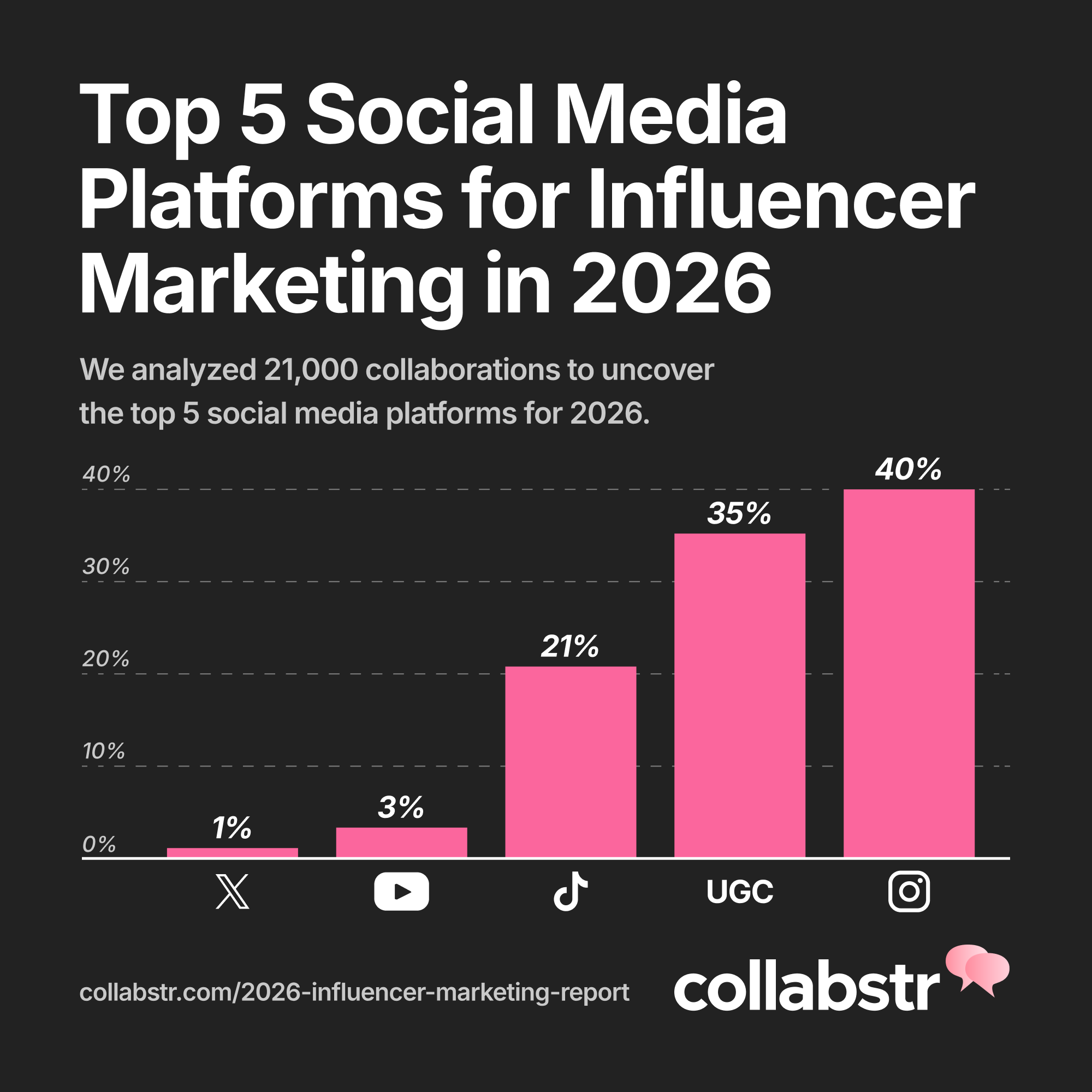
Overall, the percentage of TikTok campaigns halved, dropping from 41% to 21% of the total engagements on the Collabstr platform in 2025. There may be a few trends driving this drop.
Firstly, uncertainty around TikTok’s future in the US, following the 2024 law requiring ByteDance to divest TikTok’s American operations or face a ban, likely cooled long-term campaign investment from brands—at least at the time.
The popular social media site even went dark for US users for a number of hours in January 2025, leading to heartfelt goodbye messages from creators, big and small. This likely signaled that the long-term commercial potential of the platform was uncertain, or at the very least, challenging to work into a strategy.
Interestingly, YouTube engagements grew by 1%, potentially as a response to TikTok creators increasing their presence on the more long-form friendly platform.
UGC-specific campaigns on the platform rose, more than doubling from 15% to 35%, year over year. That sharp rise in UGC campaigns suggests brands are increasingly leaning on real customers and everyday creators for content that feels genuine, affordable, and easy to scale rather than high-budget influencer posts or risky platform-specific bets.
How Much Are Brands Spending per Engagement?
Most influencer collaborations on Collabstr fall firmly into the affordable end of the pricing spectrum. Eighty percent of all engagements cost under $300, showing that brands are prioritizing smaller, high-frequency collaborations over large, high-budget partnerships.
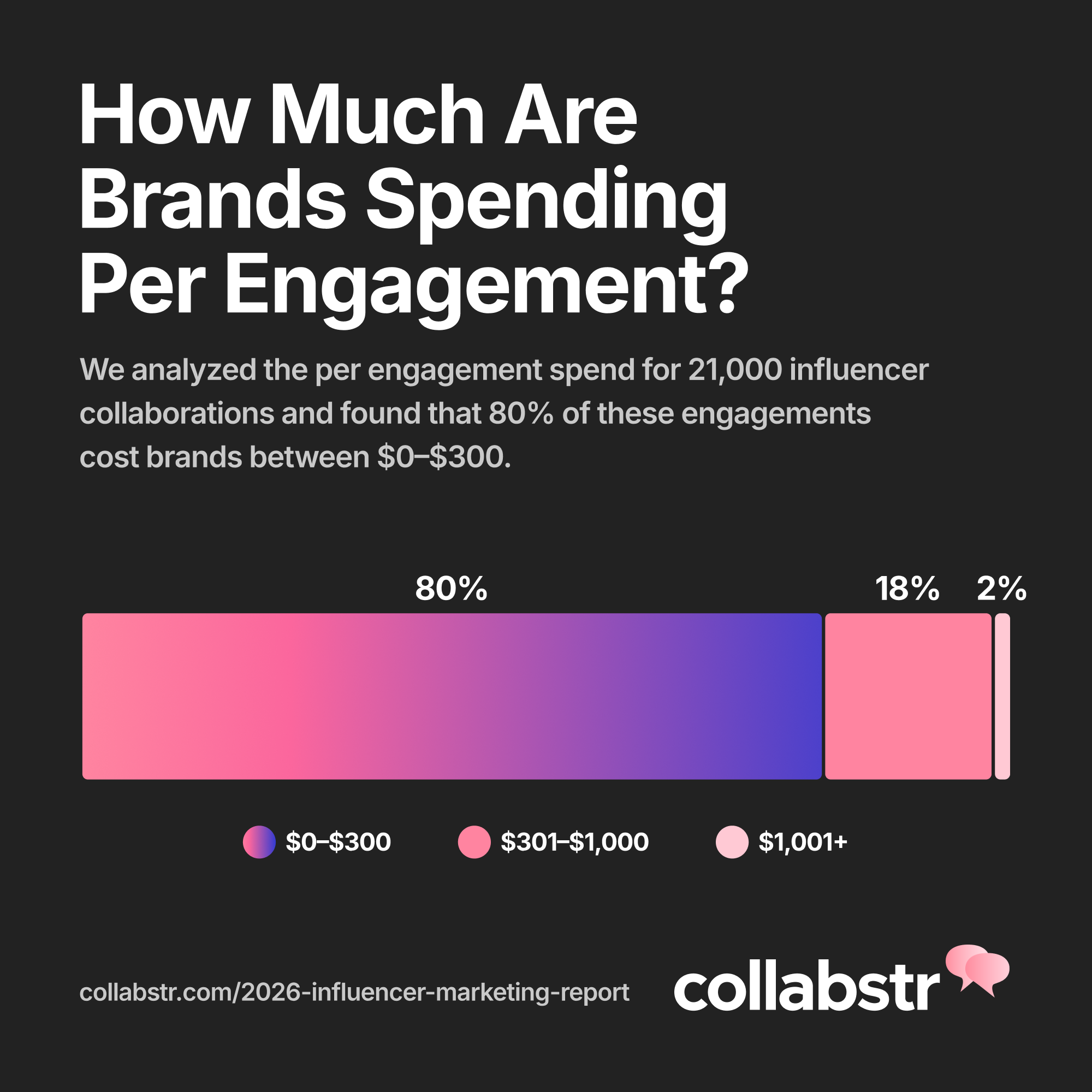
Another 18% land between $301 and $1,000, typically representing mid-sized creators or more complex content requests.
Only 2% of engagements exceed $1,000, underscoring how rare premium partnerships are relative to the overall market. This distribution highlights a clear shift toward scalable, cost-efficient creator strategies.
How much brands are spending per engagement:
Average Influencer Rates by Platform vs. Average Influencer Cost
Working with smaller creators is often preferable for companies that want to reach online audiences without spending thousands on campaigns and engagements.
It’s important to distinguish between what creators say they charge and what they’re ultimately paid. A creator’s posted rate reflects their own valuation based on their audience size, engagement, and niche, while the payout represents the final negotiated cost to the brand. The difference between these numbers highlights how much bespoke negotiation happens behind the scenes and how flexible creators can be when aligning to specific campaign goals.
Custom engagements and negotiations can change these final payouts, causing a discrepancy between asking price and final costs.
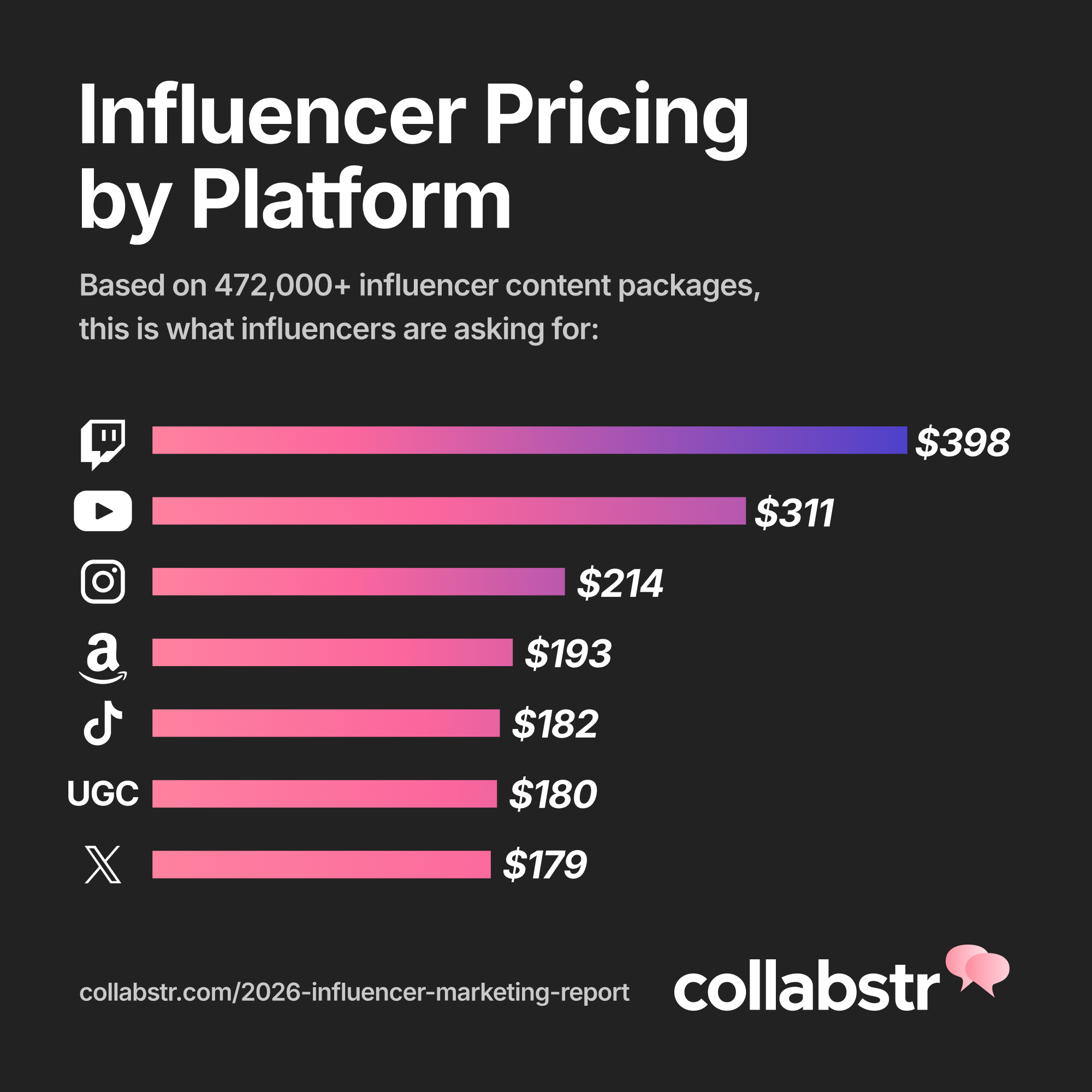
We analyzed 472,000+ packages and 21,000 collaborations on the Collabstr platform to learn more about how much influencers charge for their services and which platforms commanded the highest price tags from brands.
Average influencer pricing by platform:
-
Twitch - $398
-
YouTube - $311
-
Instagram - $214
-
Amazon - $193
-
TikTok - $182
-
UGC - $180
-
X (Twitter) - $179
Surprisingly, Twitch creators had the most expensive content packages on our platform, asking for an average of $398 per engagement. This was followed by YouTube influencers ($311) and Instagram influencers ($214) rounding out the top three most expensive influencer packages.
Achieving popularity on Twitch often means access to a highly engaged audience. In 2025, Twitch generated $115 million in revenue from in-app purchases. With 72% of its user base aged under 34, brands that want to reach a predominantly younger male audience can collaborate easily with influencers who are building their audiences on the platform with gaming, commentary, ASMR, and lifestyle content.
These Twitch influencers are able to command higher prices for collaborations because their audiences are so highly engaged, commenting and returning to consume the content of their favorite creators. Consider daily Twitch streamers like Ninja and Kai Cenat, who have amassed huge followings on the platform in just a few years making gaming and personality-driven content.
Seeing Instagram and Amazon high on the list is also no surprise. The ROI from these collaborations can be high, with brand investment on these platforms holding strong year after year. For example, for Amazon sellers, working with a dozen creators charging an average of $214 to collaborate may cost a few thousand dollars in influencer marketing fees. But when advertising to a highly relevant and engaged audience, sales made from the collaboration can pay back the investment quickly.
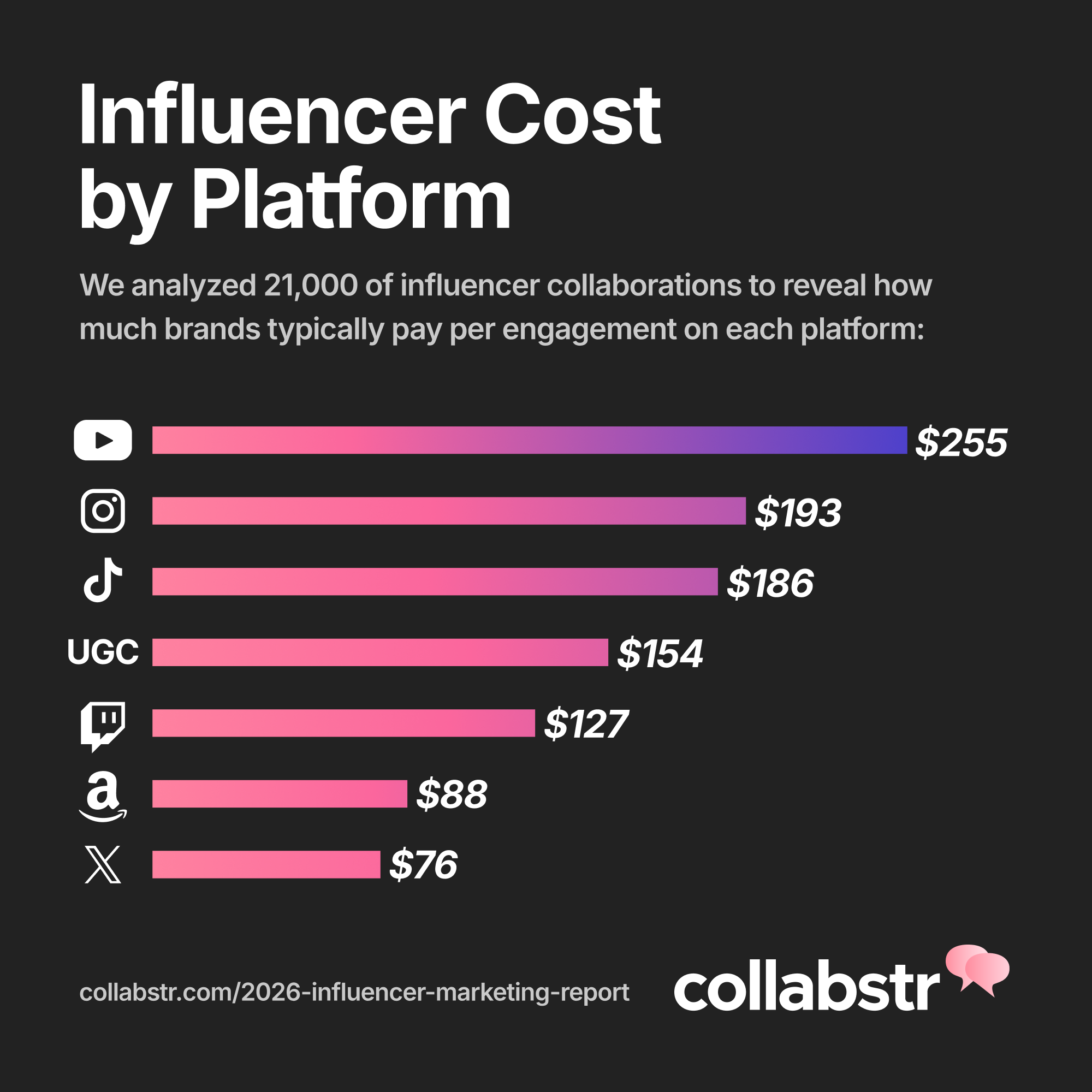
The gap between influencer packages and payout prices can be wide, however. Twitch creators, for example, typically ask for $398 per collaboration on average, but the average payout is $127 for engagements on this platform. This hints that brands are actively negotiating and working with creators on bespoke packages that meet the needs of their specific campaigns.
The lowest value packages and payouts are on X (Twitter), where the gap still exists but brands are generally running fewer influencer campaigns—just 1% of total engagements on the Collabstr platform. This trend holds year over year, signaling ongoing reluctance for brands to promote their products and services on the X (Twitter) platform.
YouTube leads on highest average payouts at $255 per engagement, down 63% year over year from $418 per engagement. This is consistent with overall spending habits we’re seeing, with 80% of influencer campaigns on the Collabstr platform coming in under $300.
Average influencer costs by platform:
-
YouTube - $255
-
Instagram - $193
-
TikTok - $186
-
UGC - $154
-
Twitch - $127
-
Amazon - $88
-
X (Twitter) - $76
These shifts show that 2025 was a year of recalibration, brands rethinking where, how, and with whom they invest. As attention redistributes across platforms and content types, the next key question becomes: What kinds of content and niches are performing best? Let’s take a deep dive into the most popular niches shaping influencer marketing right now.
Creator Niches and Pricing
Creators bring value through what they know, whether that’s beauty, gaming, fitness, or interior design. That expertise can make a big difference in how engaged their audience is and how much brands are willing to pay.
Top 5 Influencer Marketing Niches
To learn more, we analyzed 2.3M searches to learn about what types of niches brands were most interested in. The top five most in-demand niches held steady, year over year, but travel replaced food and drink in the top five.
The top five in-demand influencer niches based on 2.3 million searches on Collabstr were:
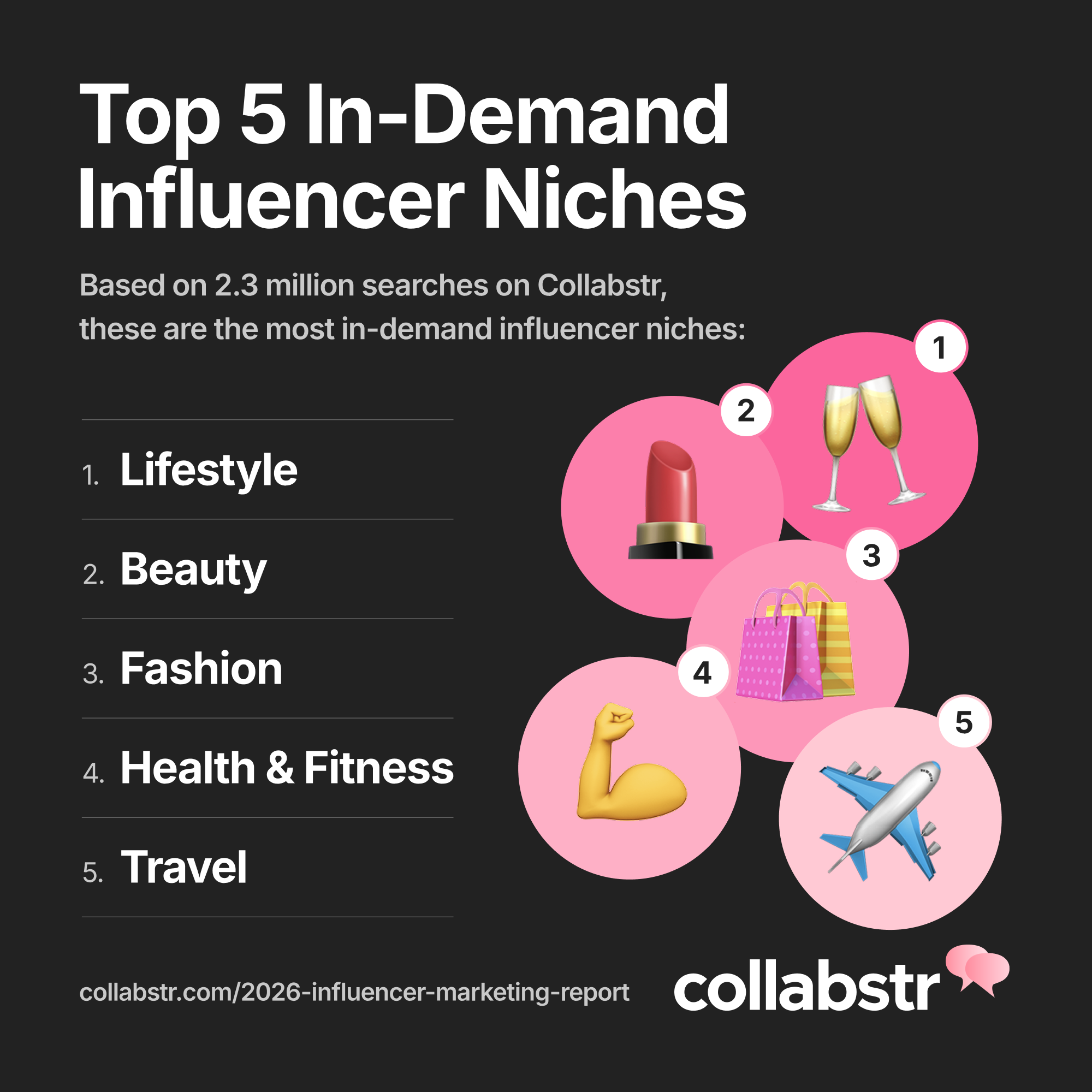
Travel’s rise into the top five reflects how much consumer behavior has shifted toward experience-driven spending.
When creators share a destination, hotel, or travel must-have, it doesn’t just entertain, it often inspires action. More than likes or comments, brands can now track real outcomes like bookings and product sales. That ability to connect storytelling to measurable results makes travel creators especially valuable, and helps explain why the category has overtaken food and drink as a top-performing niche heading into 2026.
Fastest-Growing Influencer Niches
Some influencer categories aren’t just popular, they’re accelerating. By looking at year-over-year search growth, we can see which niches are gaining momentum fastest and where brands are placing their next bets.
Fastest growing influencer niches:
-
Athlete & Sports - +108%
-
Skilled Trades - +103%
-
Health & Fitness - +76%
-
Adventure & Outdoors - +67%
-
Family & Children - +54%
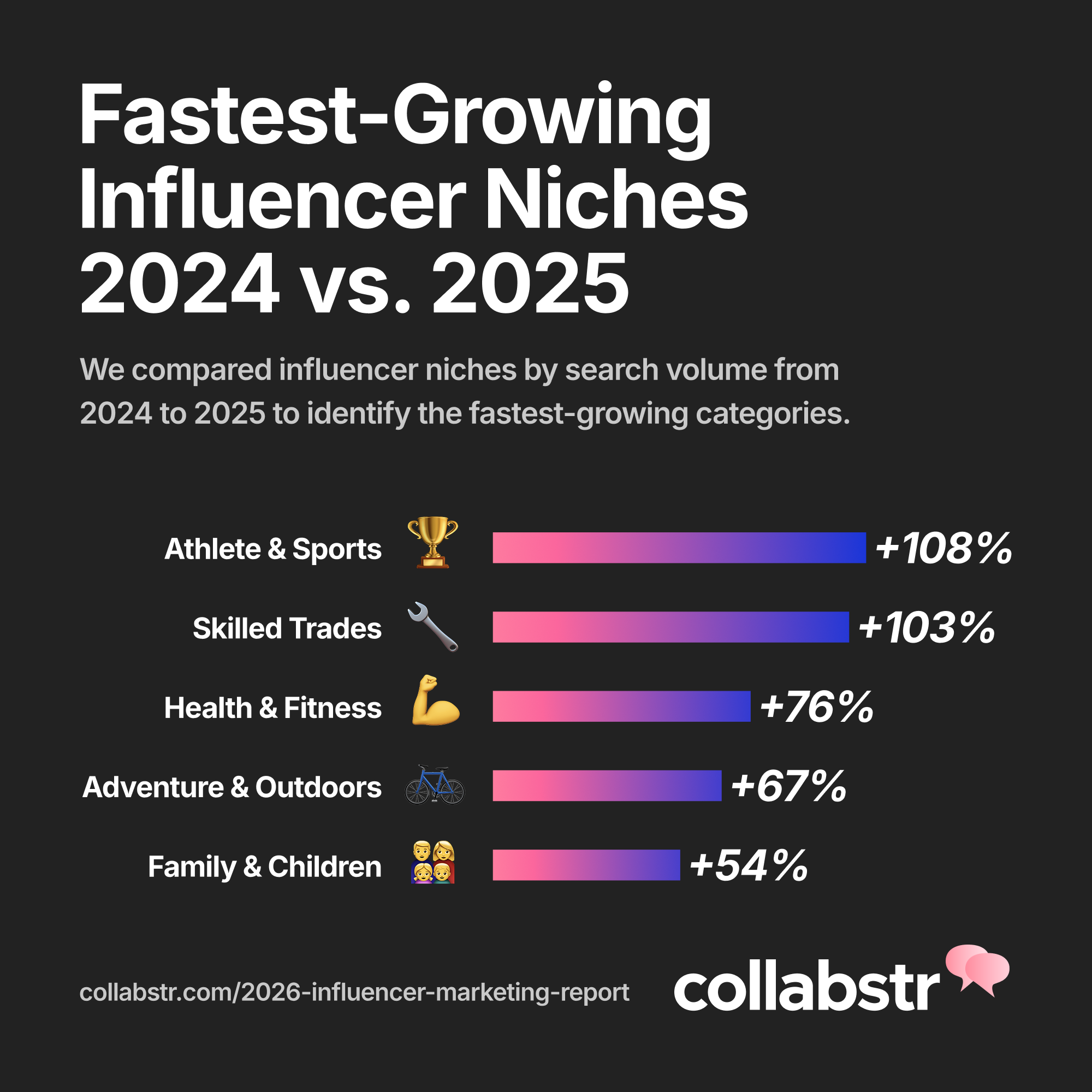
The overall fastest-growing niche on the Collabstr platform was Athlete & Sports, up 108% year over year, followed by Skills & Trades, up 103% year over year. In fact, four of the top five fastest-growing niches reflect trends in wellness, self improvement, and learning/development.
This may coincide with the general popularity of self-improvement trends on social media and a slowdown in the growth of traditionally popular niches like Fashion and Beauty.
Zippo reports that more than 70% of self-improvement social media content is shared organically, which indicates high user engagement and interest.
Fastest-Growing Niches: What’s Driving Their Rise?
1. Athlete & Sports (+108%)
Sports influencers often share authentic, aspirational content that taps into community and identity, making branded collaborations feel personal and trustworthy. In fact, 58% of 16–24 year olds and 49% of 25–34 year olds say they follow athletes on social media, delving deeper into their lives, routines, and recommendations.
2. Skilled Trades (+103%)
Creators in skilled trades bring real-world expertise and often fill a knowledge gap for viewers, whether it’s DIY, home renovation, carpentry, plumbing, or other crafts. Their content resonates because it offers practical value, education, and problem-solving advice.
3. Health & Fitness (+76%)
Post-pandemic wellness culture has surged. In one McKinsey survey, 58% of US respondents said they were prioritizing health and wellness more now than they did a year ago. Fitness influencers often combine personal storytelling with product reviews (supplements, gear, apparel), making them strong conversion drivers.
4. Adventure & Outdoors (+67%)
Travel, adventure, and outdoor-lifestyle content sells the dream of experience and exploration which is becoming more appealing in an age where experiences often matter more than material goods. As hobbies, outdoor adventures can be seen as more cost effective and fulfilling than other types of activities.
5. Family & Children (+54%)
Family and child-focused content often combines relatability, trust, and long-term engagement. Parents and caregivers follow creators who provide advice, honest reviews, and genuine family lifestyle inspiration. New and upcoming regulations around “kidfluencing” may impact the continued rise of this niche.
Top 5 Most Expensive Niches
Not all creator partnerships cost the same. Certain niches command higher rates because their audiences are highly engaged, highly targeted, or highly willing to spend, making these creators some of the most valuable on the market.
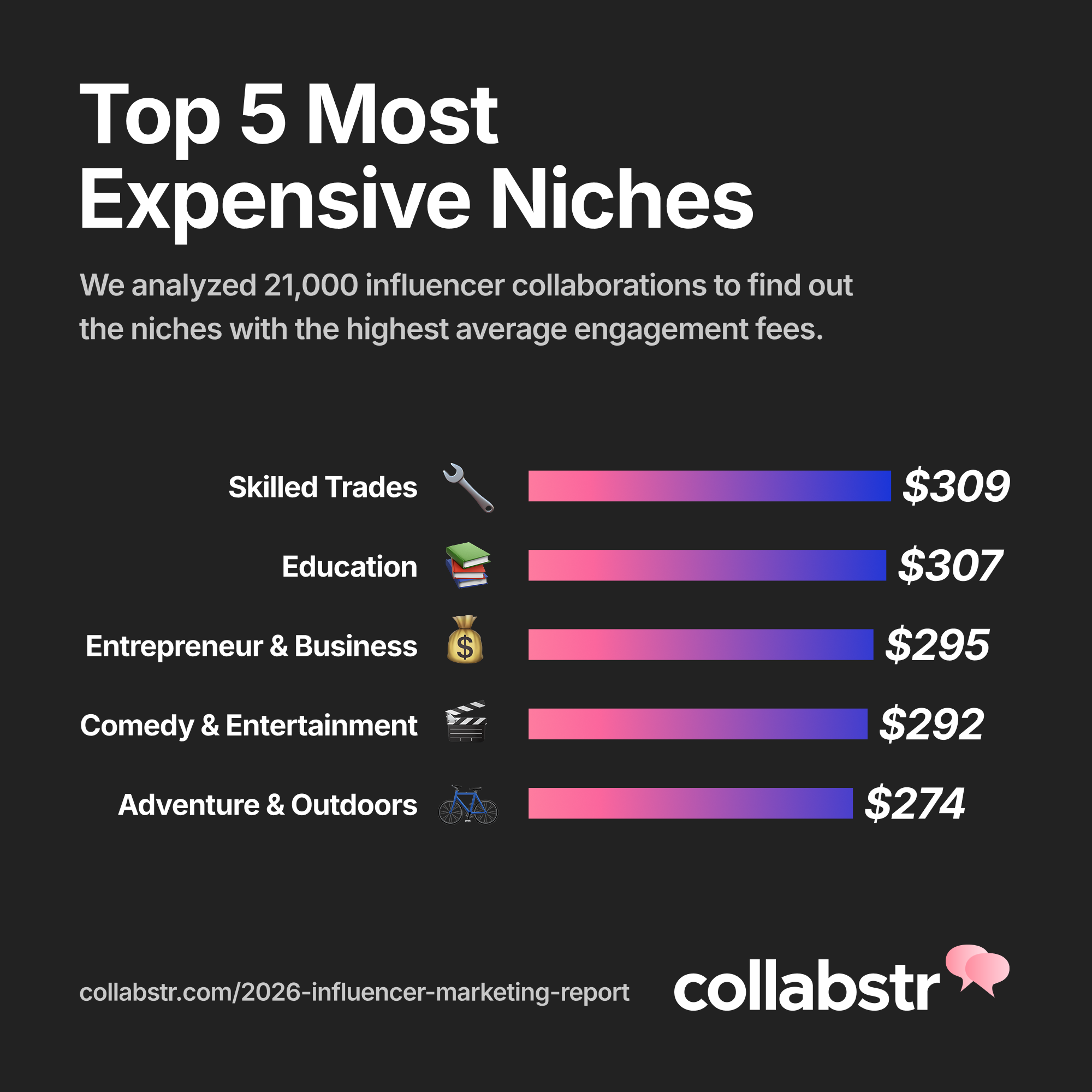
We analyzed 21,000 collaborations and learned that the top five most expensive niches were:
-
Skilled Trades - $309
-
Education - $307
-
Entrepreneur & Business - $295
-
Comedy & Entertainment - $292
-
Adventure & Outdoors - $274
Looking at the top five niches commanding the highest average rates, two clear dynamics stand out. First, categories like Skilled Trades, Education, and Entrepreneurship are built on expertise, which naturally attracts audiences who are actively seeking guidance.
These are high-intent followers who are already in the market for tools, courses, and solutions, making their eventual purchasing behavior more likely. Take a language-learning creator as an example: their audience isn’t just casually scrolling; they’re motivated learners. When that creator recommends an app, a class, or even a cultural immersion trip, the conversion potential is immediate and measurable.
That direct line between trusted advice and real purchasing outcomes is what drives up creator value in expertise-based niches.
Top 5 Most Affordable Niches
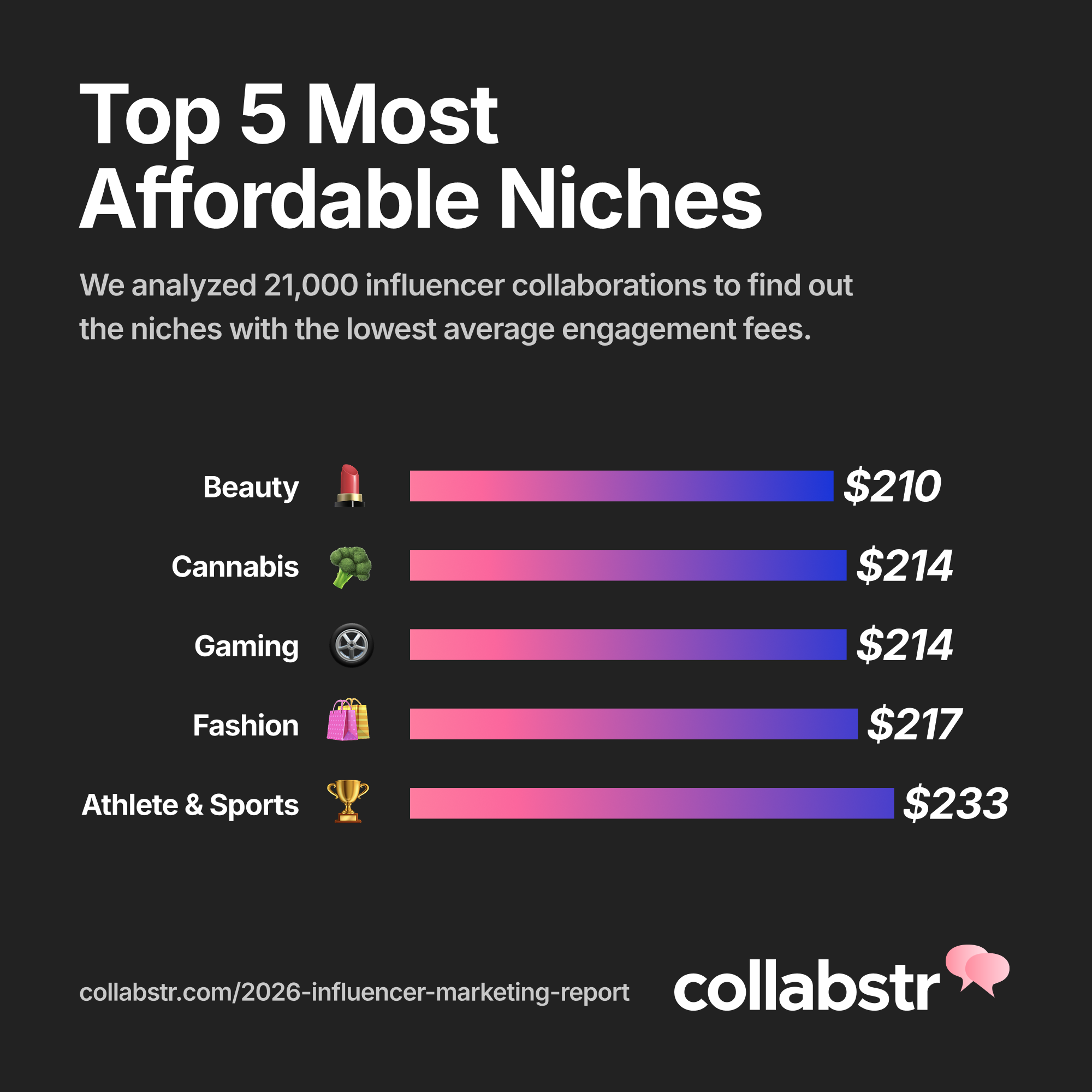
At the lower end of the pricing spectrum, we see niches like Beauty, Fashion, Gaming, Sports, and Cannabis. These categories attract a large number of creators, which leads to a highly competitive marketplace. When supply is high and many creators are offering similar styles of content, rates naturally stay lower. Many of the formats popular in these niches are also faster and cheaper to produce, reducing the baseline cost of each collaboration.
Niches with the lowest average engagement fees:
-
Beauty - $210
-
Cannabis - $214
-
Gaming - $214
-
Fashion - $217
-
Athlete & Sports - $233
These niches typically drive broad awareness rather than high-value conversions, which affects how much brands are willing to pay.
As a result, these categories remain more cost-efficient for brands and more accessible for creators looking to build a presence, even if the individual payouts are smaller than in expert-driven niches.
Of course, niche is only half the equation. To understand performance and ROI we also need to look at what types of content creators are making.
Content Types and Performance
The type of content creators produce plays a major role in how audiences engage and how far a message travels. While some formats are designed to capture quick attention and big reach, others drive deeper interaction and more meaningful signals of interest.
What Type of Content Are Brands Requesting Most?
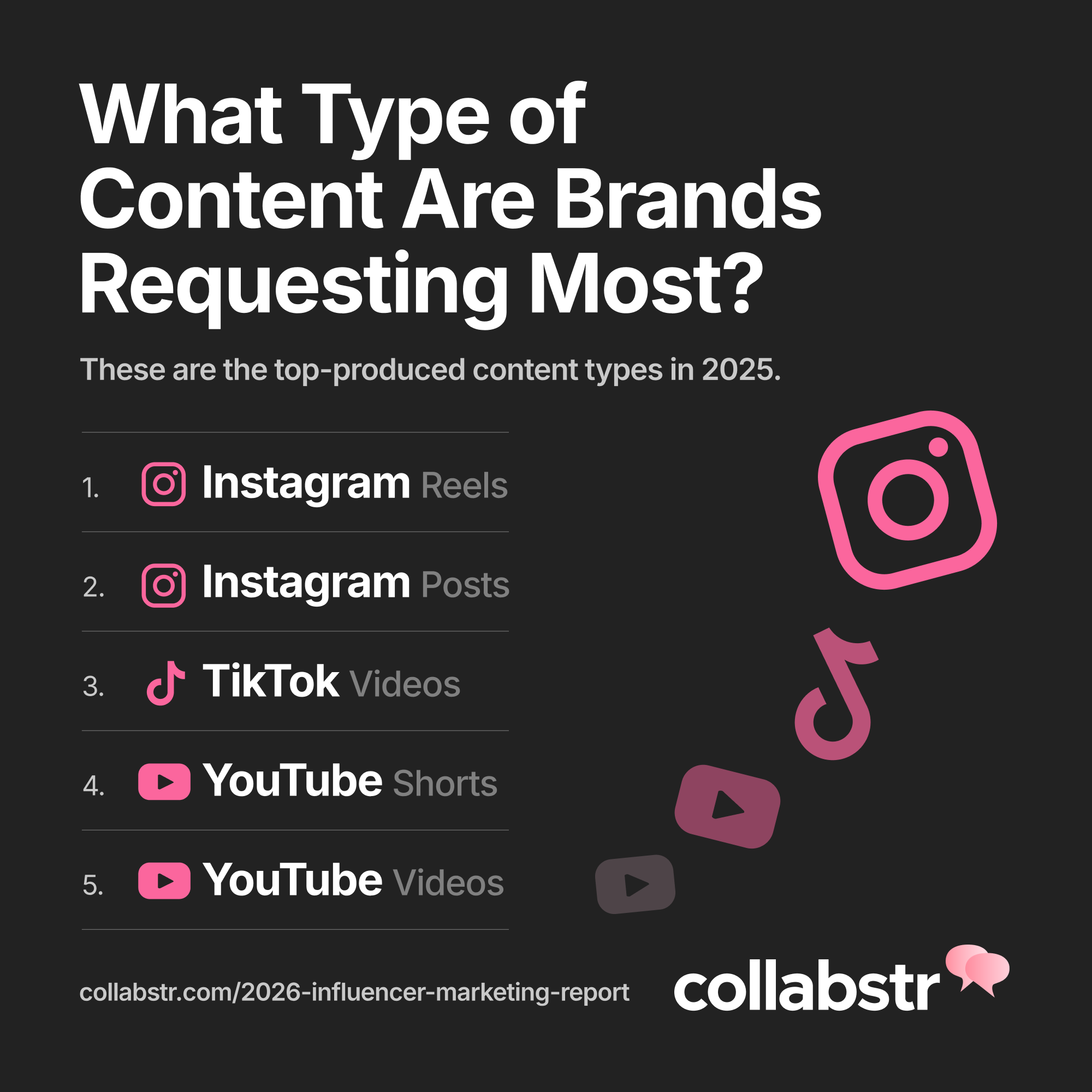
These are the top types of content that were created in 2025.
-
Instagram Reels
-
Instagram posts
-
TikTok videos
-
YouTube Shorts
-
YouTube videos
This top five tells us a few things. Firstly, Instagram is still the go-to destination for brands serious about ROI and influencer campaigns. Secondly, video remains the winning format, with Reels, videos, and Shorts being the most requested content type from brands.
Top Social Media Influencer Content by Reach (Impressions)
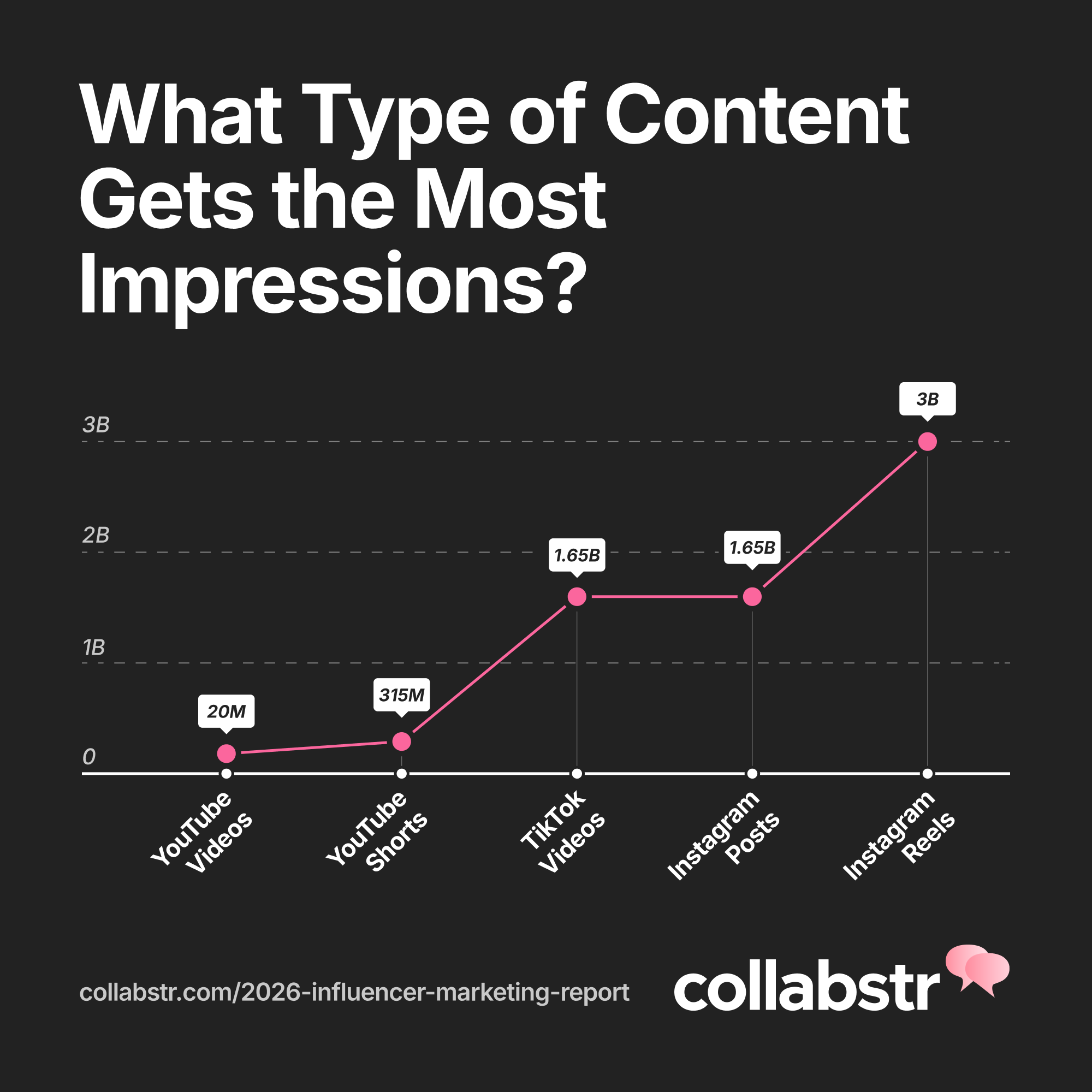
What’s interesting is that the formats brands request most are the same formats that deliver the highest reach.
Top content type by impressions:
-
Instagram Reels
-
Instagram posts
-
TikTok videos
-
YouTube Shorts
-
YouTube videos
Instagram Reels, Instagram posts, TikTok videos, and YouTube Shorts sit at the top of both lists, showing strong alignment between brand demand and audience behavior.
Top Social Media Influencer Content by Engagement
From an engagement perspective, the top formats hold. Engagement looks at not just viewership and reach, but sharing, liking, and commenting as deeper indicators of interest. The content formats driving the greatest engagement are:
-
YouTube videos: 6%
-
Instagram Reels: 5%
-
YouTube Shorts: 4.5%
-
Instagram posts: 3.5%
-
TikTok Videos: 2%
Even though short-form dominates impressions and demand, long-form YouTube videos translate to the deepest engagement. When viewers choose to watch longer content, they’re generally more invested, leading to more likes, comments, shares, and stronger signals of true interest.
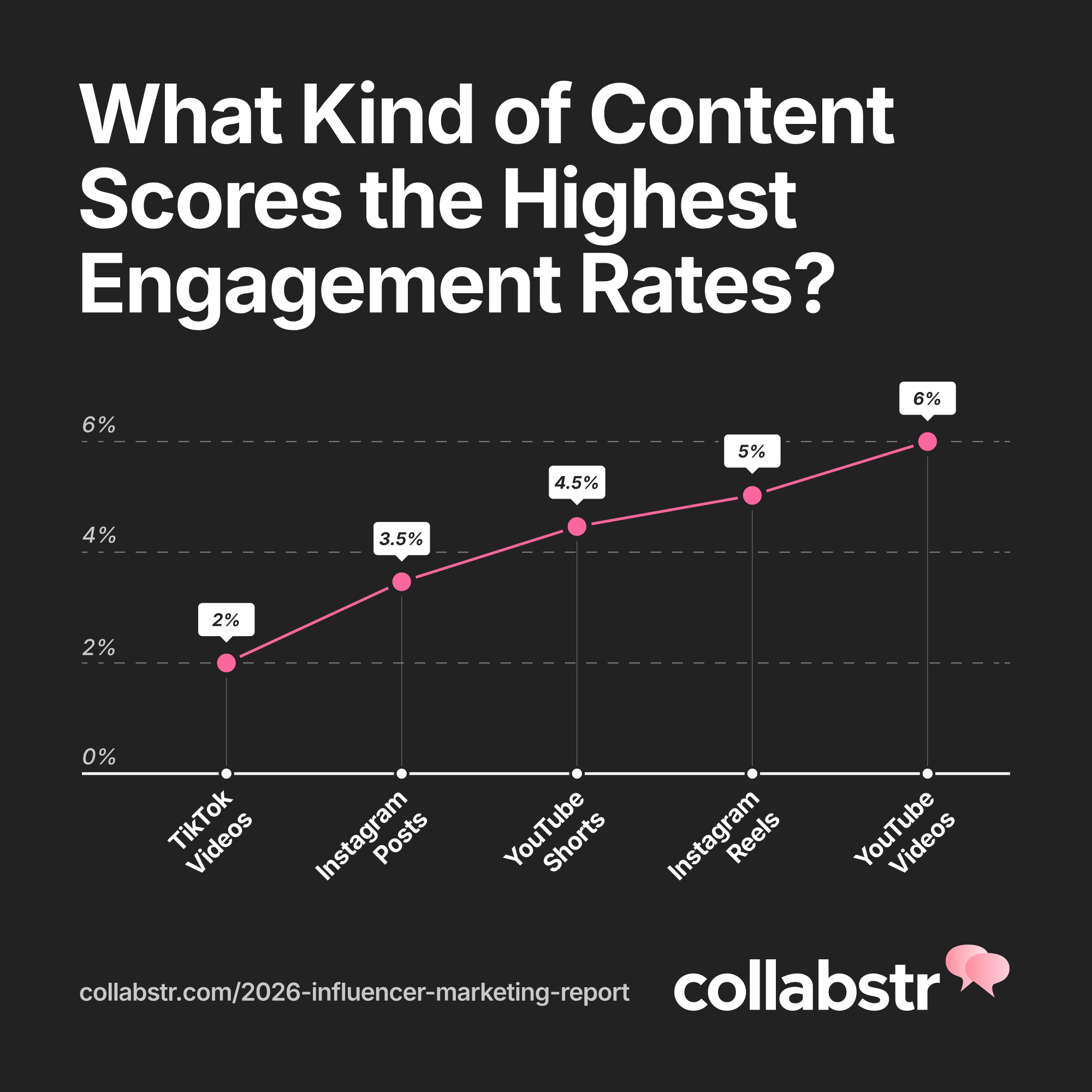
Instagram Reels and YouTube Shorts still perform well because they’re fast, fun, and easy to interact with, but the engagement rate step-down suggests that quick consumption doesn’t always translate into meaningful action.
With brands doubling down on formats that deliver fast reach and measurable attention, creators are adapting quickly. But reach and engagement are only one piece of the story. Increasingly, brands want assets they can reuse. That shift brings us to one format that’s rapidly reshaping how brands collaborate with creators: UGC.
User-Generated Content
In 2025, UGC engagements on Collabstr more than doubled year over year, rising from 15% to 35% of all influencer campaigns. In this section, we explore how UGC costs are shifting and what types of companies are driving this growth.
According to Adweek, UGC content drove 29% higher conversions than non-UGC campaigns. UGC often comes from everyday customers or creators rather than brand marketers, which gives it a more genuine, unscripted feel. People trust other consumers more than corporate advertising when making purchase decisions.
Year over year, the cost of UGC campaigns dropped by 5.7% on the Collabstr platform from an average of $209 to an average of $197.
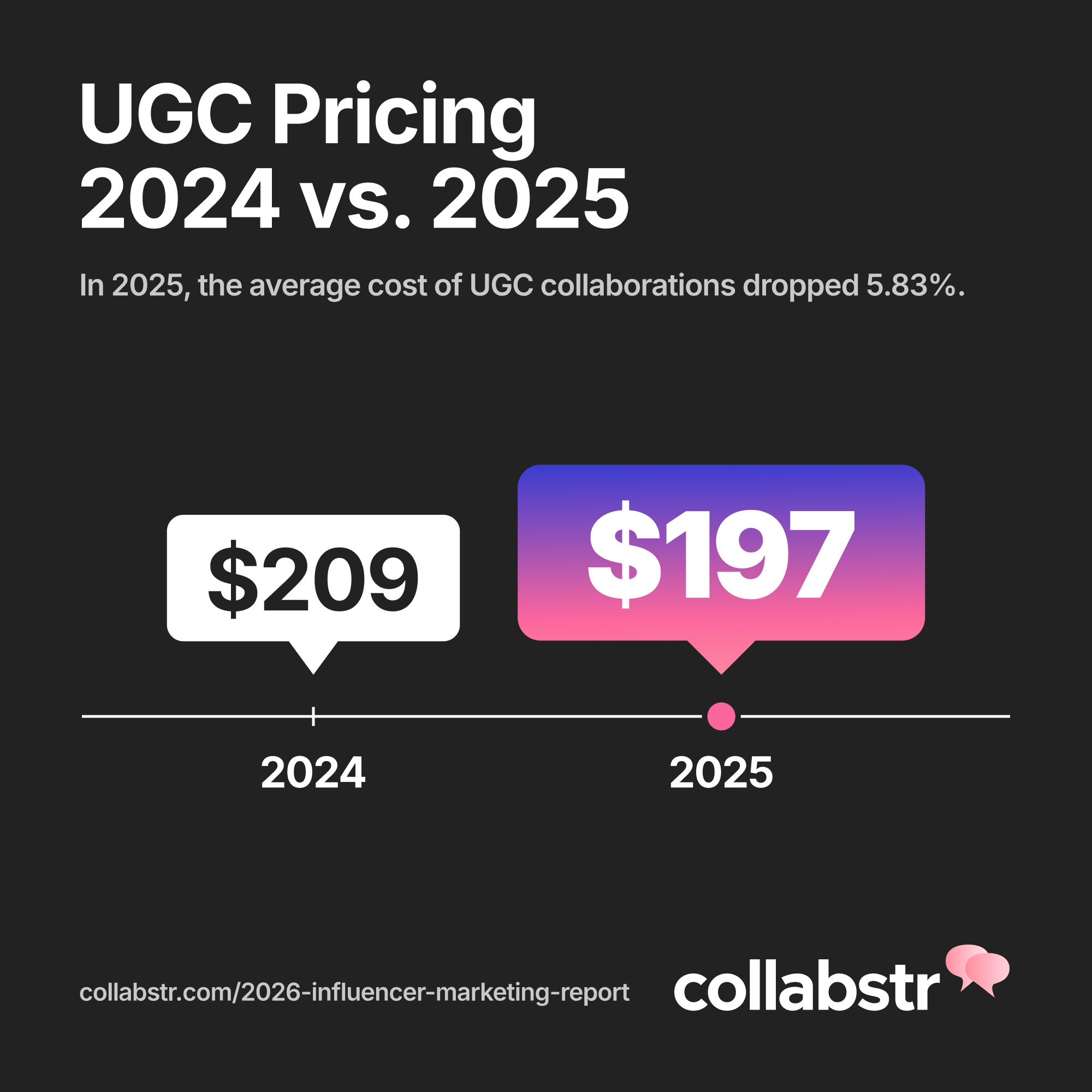
As UGC continues to gain in popularity, falling prices reflect a market where content is easier to produce, creators are more prevalent, and brands prioritize ROI over pure aesthetics.
When it comes to the types of companies running UGC campaigns, it’s clear that small and mid-sized businesses are leading the pack
UGC is being driven primarily by smaller brands with smaller budgets. Over 40% of UGC campaigns come from companies spending less than $5k.
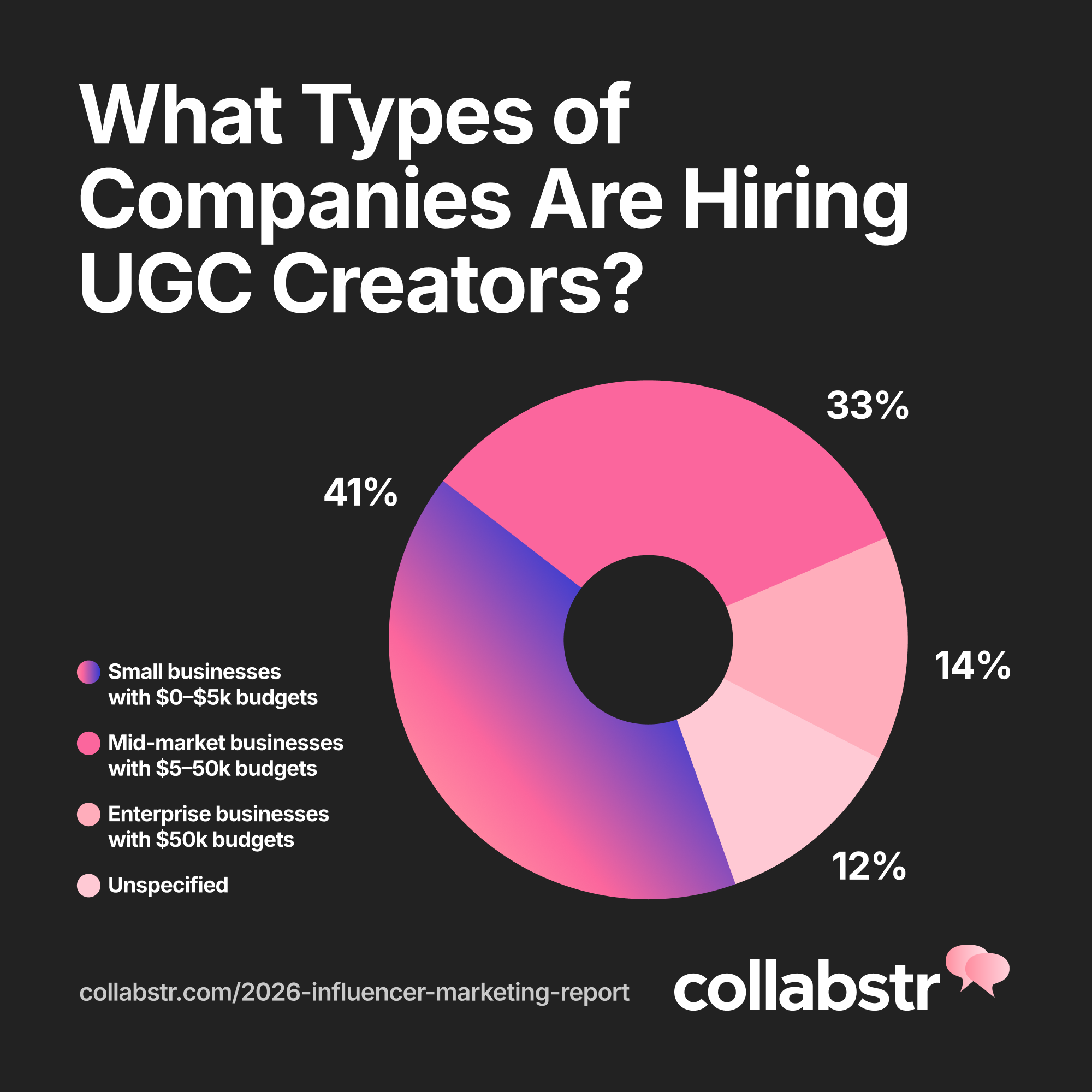
In fact, nearly 80% of brand collaborations cost under $300, meaning that micro-engagements are more appealing to smaller companies.
3 Reasons UGC Campaigns Are Attractive for Small Businesses
1. Affordable way to produce high-quality content
Small businesses rarely have in-house creative teams. UGC gives them a steady stream of product photos, videos, and testimonials without expensive production costs.
2. Social proof that builds trust quickly
When customers see real people using and loving a product, it boosts credibility instantly, which is critical for brands that don’t yet have name recognition.
3. Platform-agnostic flexibility
UGC can be used everywhere—websites, ads, email, organic social, product pages—meaning every piece of content stretches further and delivers more value per dollar.
As UGC and performance-focused content reshape how brands collaborate with creators, it’s just as important to understand who those creators are and where they’re reaching audiences.
Demographics and Geography
From gender differences in niche specialization, to regional hotspots where creator communities thrive, this section explores who is powering the creator economy.
Gender continues to shape where creators show up in the influencer economy, with clear differences in niche focus and audience appeal. On our platform, male influencers make up just 18% of our creator base, while female influencers make up 80% of creator talent in our marketplace. A further 2% were non-indentified.
Top Niches by Gender
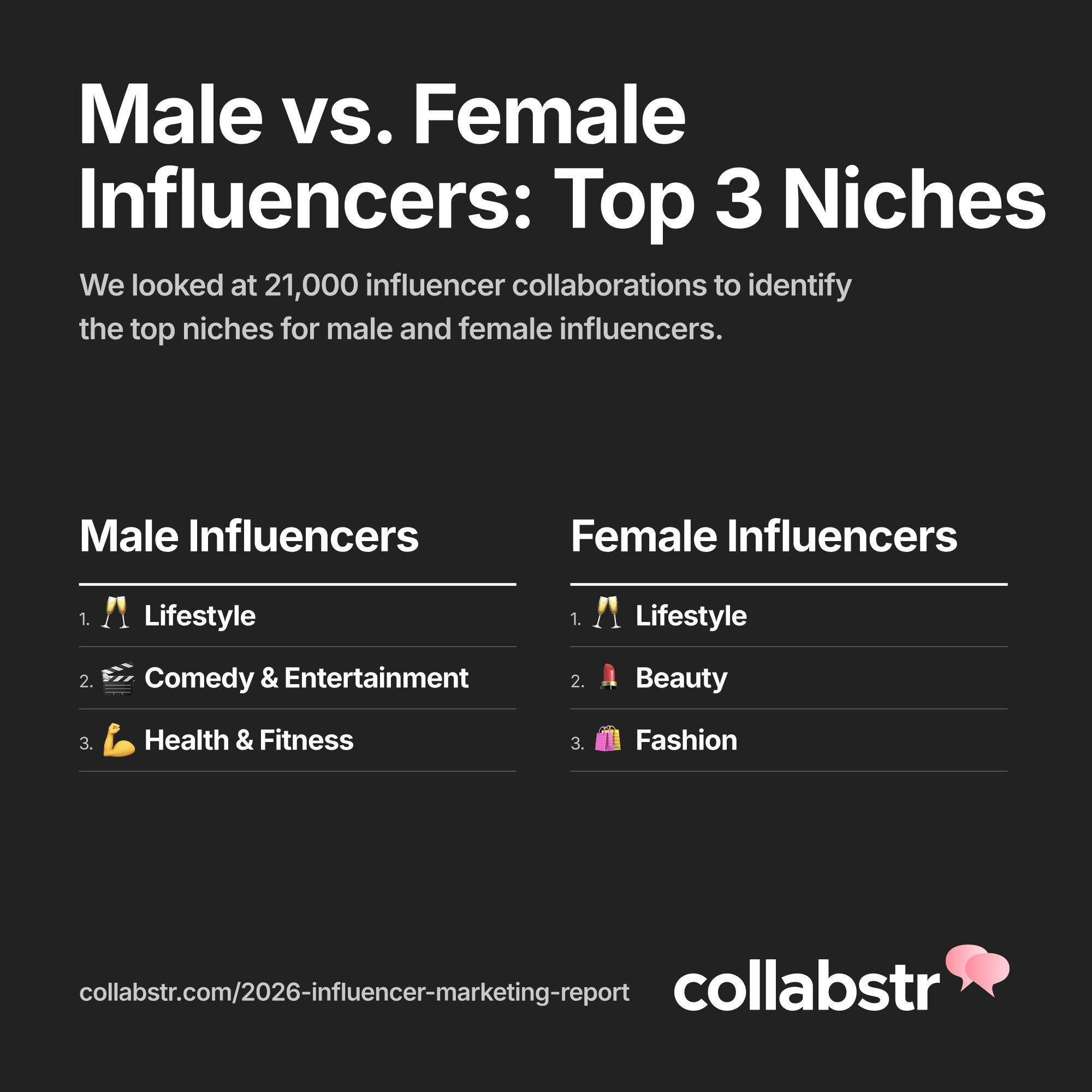
We looked at 21,000 influencer collaborations to identify the top niches for male and female influencers.
Top male influencer niches
-
Lifestyle - 20%
-
Comedy & Entertainment - 10%
-
Health & Fitness - 10%
Top female influencer niches
-
Lifestyle - 25%
-
Beauty - 17%
-
Fashion - 15%
Women dominate product-discovery categories while men over-index in expertise and entertainment-driven niches, driving up average payout cost with pricier niches and a smaller overall presence on the platform.
Male vs. Female Average Earnings: The Pay Gap Persists
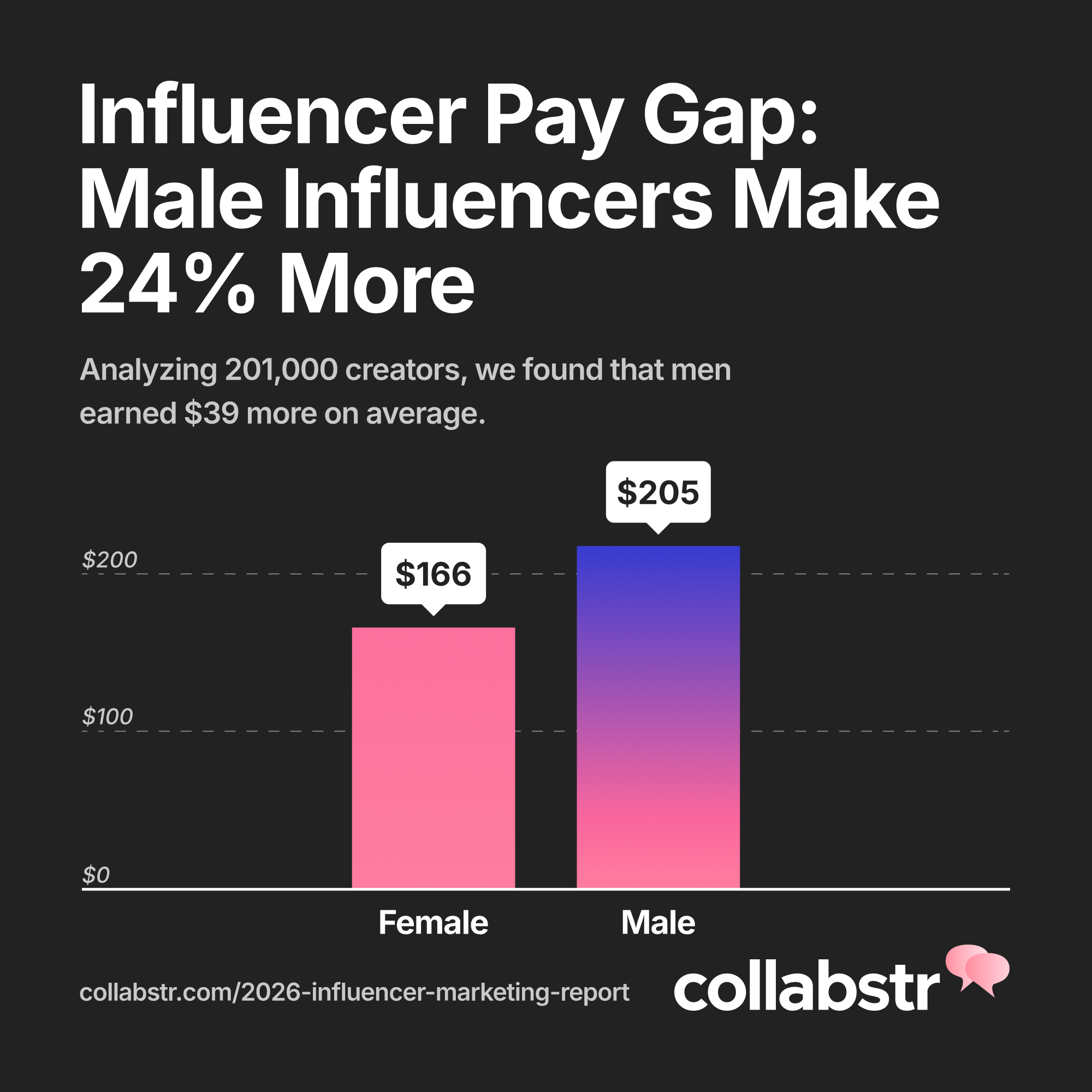
Despite women representing the majority of creators on our platform and in highly commercial niches like Beauty and Fashion, a pay gap persists: Men continue to earn more per collaboration than women, both this year and last.
The influencer pay gap: Men earned ~24% more per engagement than women
The influencer pay gap is well documented. We’ve covered it in previous reports and research confirms that the pay gap doesn’t just exist across gender but across race and other identity pillars.
Across our analysis of 21,000 collaborations, male creators earned an average of $205 per engagement in 2025, compared to $166 for women. While both averages declined year over year (down from $291 and $208, respectively) the gap remains.
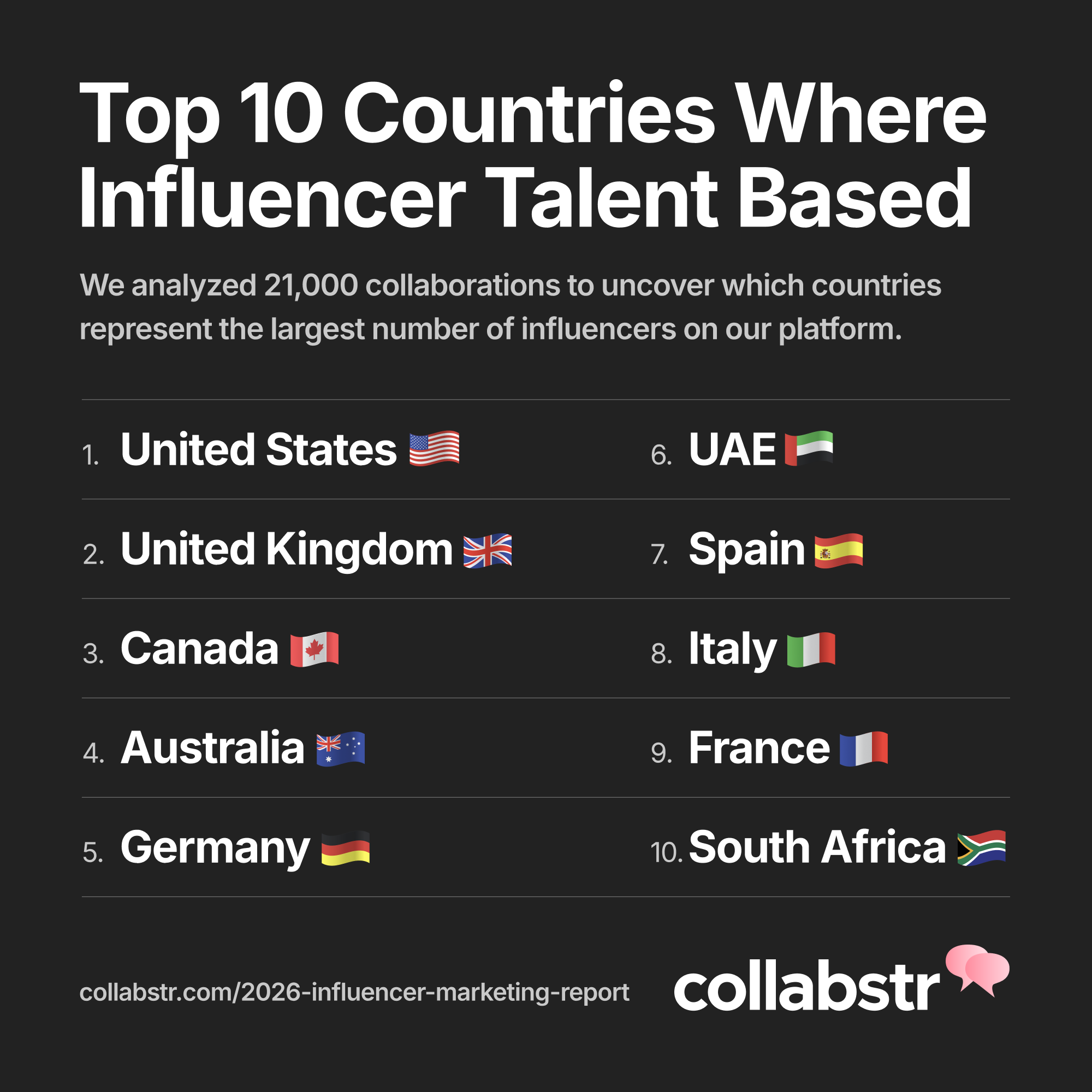
The top 10 countries where influencer talent is based:
-
United States
-
United Kingdom
-
Canada
-
Australia
-
Germany
-
United Arab Emirates
-
Spain
-
Italy
-
France
-
South Africa
This spread shows that influencer talent remains heavily concentrated in Western, English-speaking markets. With the United States driving 66% of all collaborations, the center of gravity for creator work is still tied to regions with large consumer economies, strong digital advertising spend, and deeply established creator ecosystems.
The presence of countries like the UK, Canada, Australia, and Germany reinforces that brands tend to invest where audiences have high purchasing power and where social media usage is deeply embedded in everyday life.
Top 5 Cities for Influencer Talent in the US
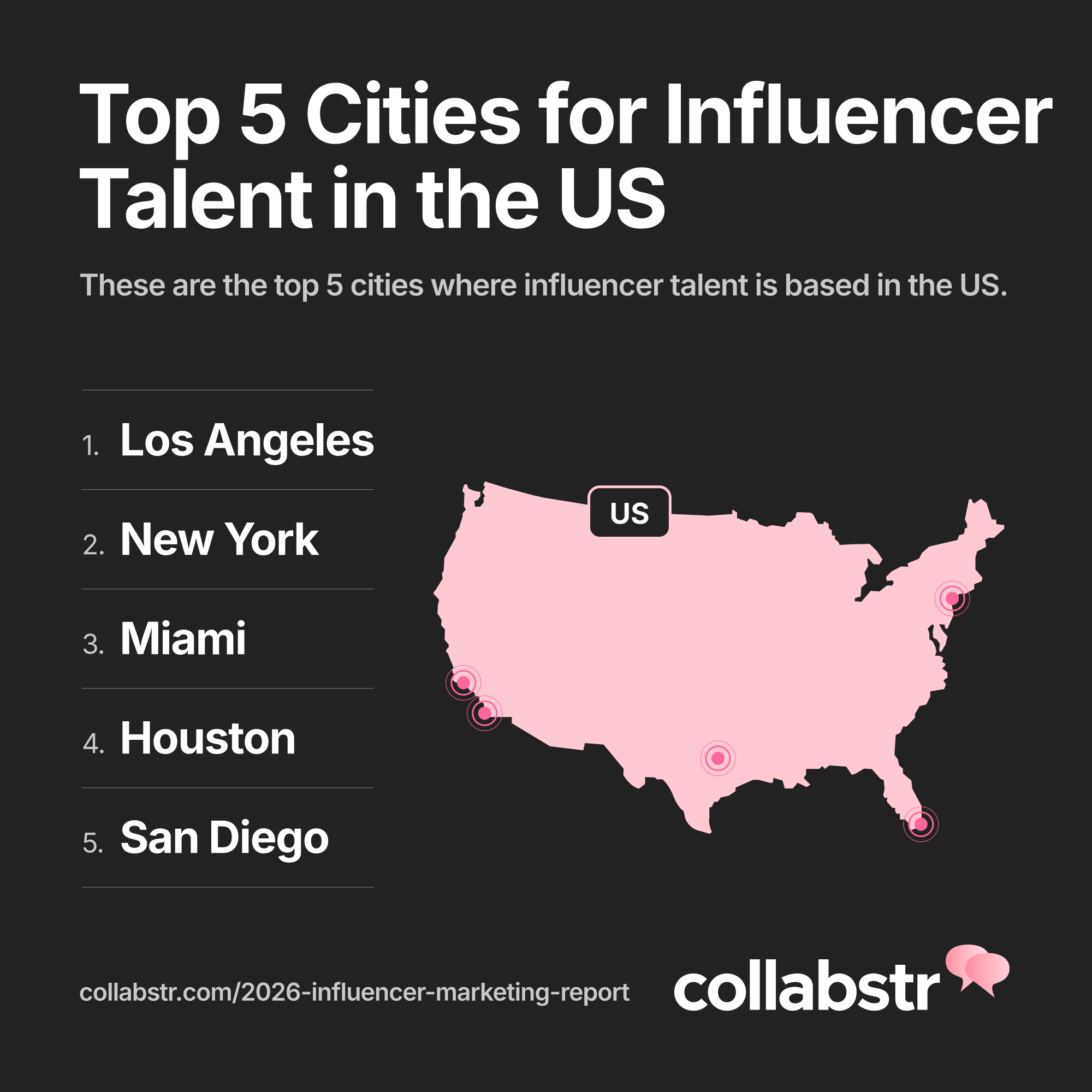
These are the top 5 cities where influencer talent is based in the US:
-
Los Angeles
-
New York
-
Miami
-
Houston
-
San Diego
Los Angeles and New York remain the core of the creator economy, driven by entertainment, fashion, and media, and hold on to their top spots from last year. Changes year over year include the rise of Houston and San Diego which edged out Atlanta and Dallas as major creator hubs in the US.
Top 5 Cities for Influencer Talent in the UK
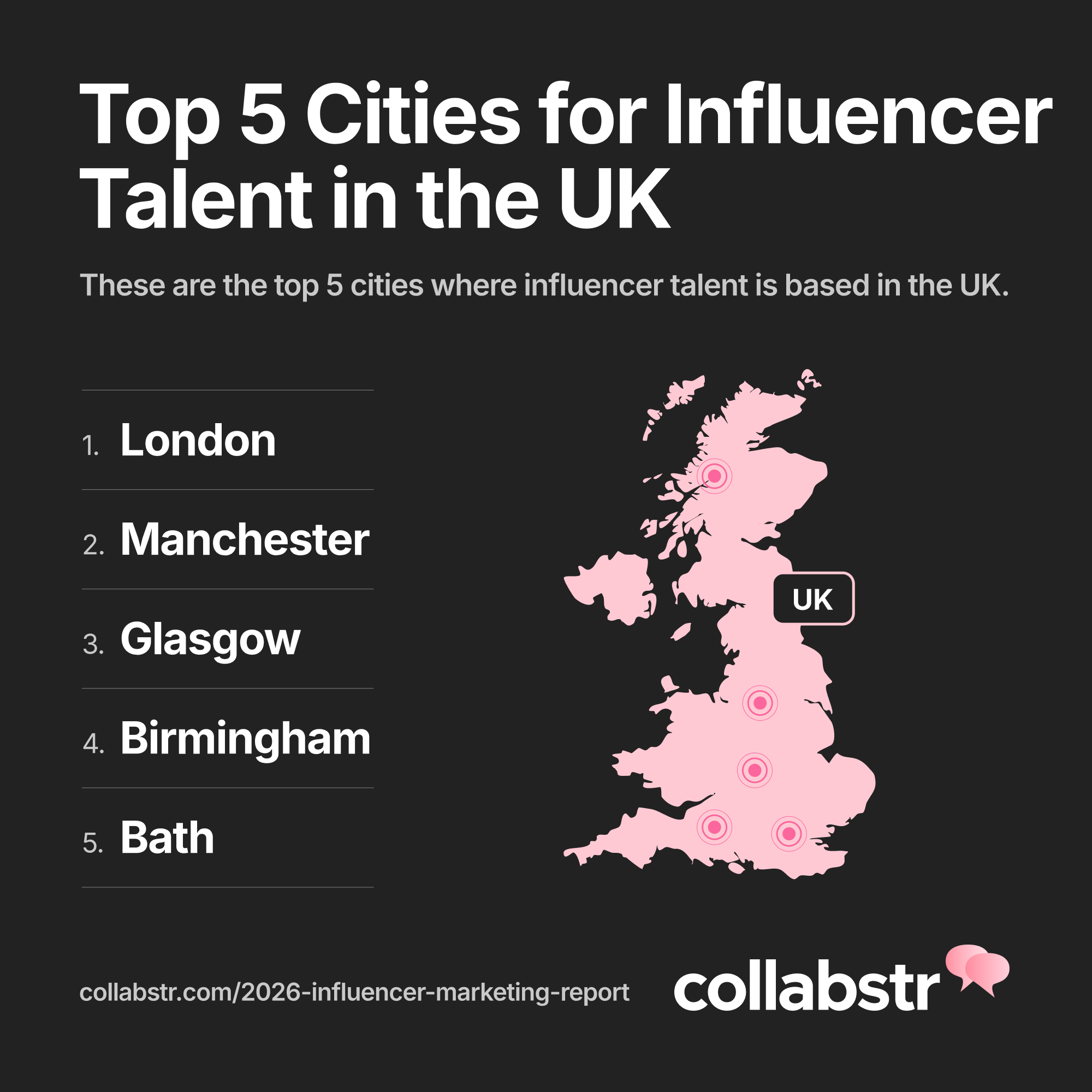
These are the top 5 cities where influencer talent is based in the UK:
-
London
-
Manchester
-
Glasgow
-
Birmingham
-
Bath
London continues to dominate the landscape, supported by major fashion, media, and beauty industries. The presence of Manchester, Glasgow, and Birmingham in the top five reflects what we know about population centers and regional hubs in the UK.
Last year, Leeds, Kent, and Glasgow rounded out the bottom three of the top five cities list.
Top 5 Cities for Influencer Talent in Canada
These are the top 5 cities where influencer talent is based in Canada:
-
Toronto
-
Vancouver
-
Montreal
-
Calgary
-
Kelowna
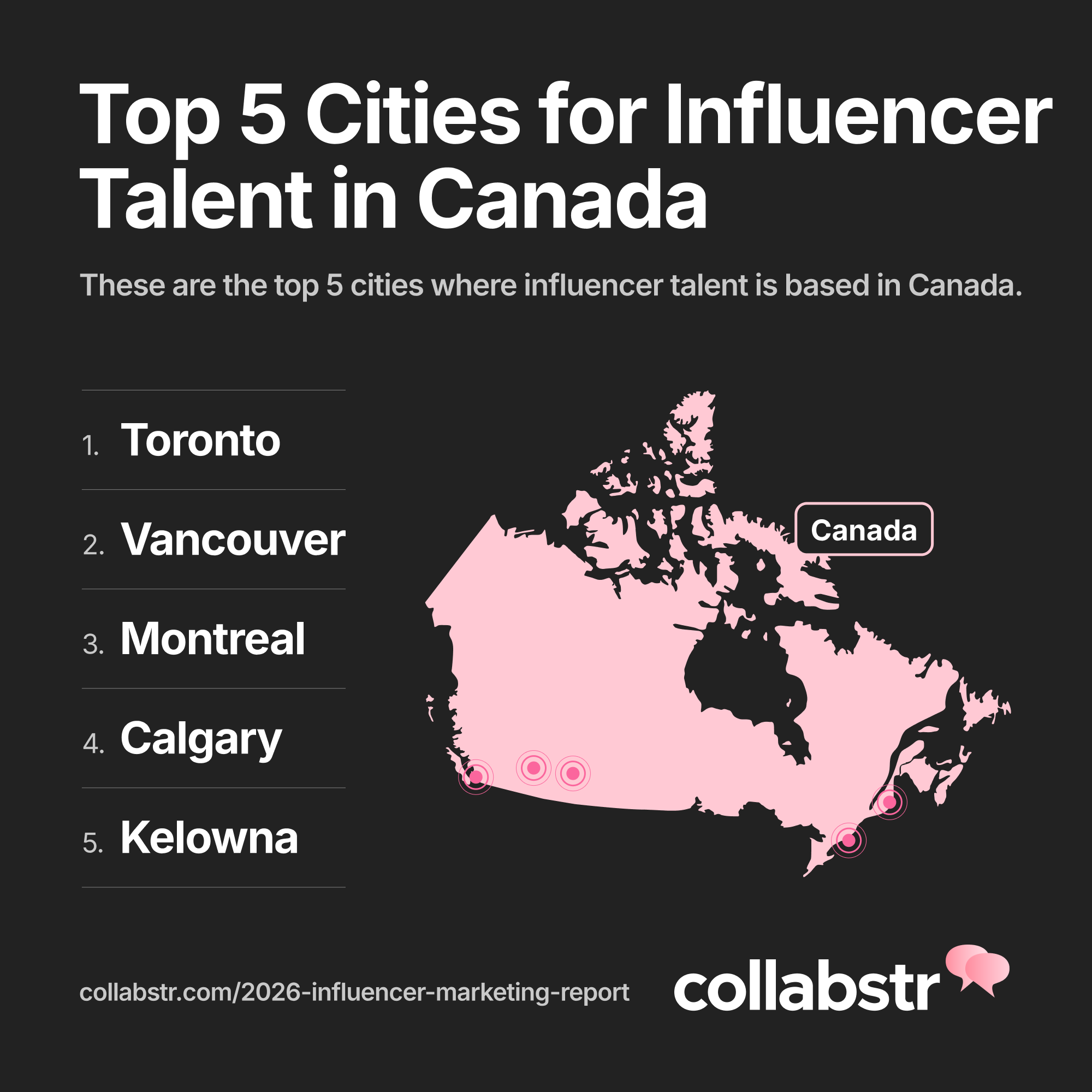
Little changed year over year in the top five Canadian cities ranking, suggesting relative stability in the country’s influencer marketing space. Ottawa did drop out of the top five, replaced by Kelowna.
Looking Ahead: Three Predictions for 2026 and Beyond
The shifts in platform dominance, creator pricing, niche growth, and content formats revealed in this report point to a creator economy that continues to optimize, grow, and mature. But also one that is influenced by country-specific legislation, a shift to prove ROI, and changing strategies.
We’re seeing three major trends we think will shape influencer marketing in 2026 and beyond.
UGC Is Paving the Way for Smarter, Scalable Influencer Marketing
What the data says:
-
UGC campaigns doubled YoY
-
40%+ of UGC buyers are small businesses
What this means:
Creators and brands will move away from platform-first strategies and toward content-first, repurposable assets. Brands will increasingly want assets they can repurpose, own, and use across any platform.
High-intent, Expert Content Is Becoming More Valuable to Brands and Audiences
What the data says:
-
Skilled Trades, Education, Entrepreneur/Business are among the most expensive niches
-
Athlete & Sports, Trades, Health & Fitness are among the fastest-growing niches
What this means:
Influence rooted in knowledge, problem-solving, and credibility is becoming more commercially valuable than purely aesthetic content because of its bias toward engagement and recommendation potential.
Small Budgets and Micro-Engagements Will Continue to Make Up the Majority of Influencer Engagements
What the data says:
-
80% of collaborations cost under $300
-
40%+ of UGC buyers are small businesses
What this means:
Small and mid-sized businesses now make up the bulk of influencer spend, signaling that everyday brands, not just large advertisers, are shaping how creator marketing grows.
Influencer marketing is evolving into a high-volume, low-cost ecosystem where small budgets and micro-engagements remain the dominant mode of brand investment.
Putting These Insights into Action With Collabstr
As these trends accelerate, brands need a platform that makes creator discovery, outreach, and collaboration simple. Collabstr connects you with thousands of vetted creators across every niche, budget, and platform helping you produce content at scale, manage campaigns more efficiently, and stay ahead of what’s working in the market.
Whether you’re testing UGC, building long-term creator partnerships, or launching multi-platform campaigns, Collabstr’s influencer marketing platform gives you the tools to move faster and make smarter investments.


